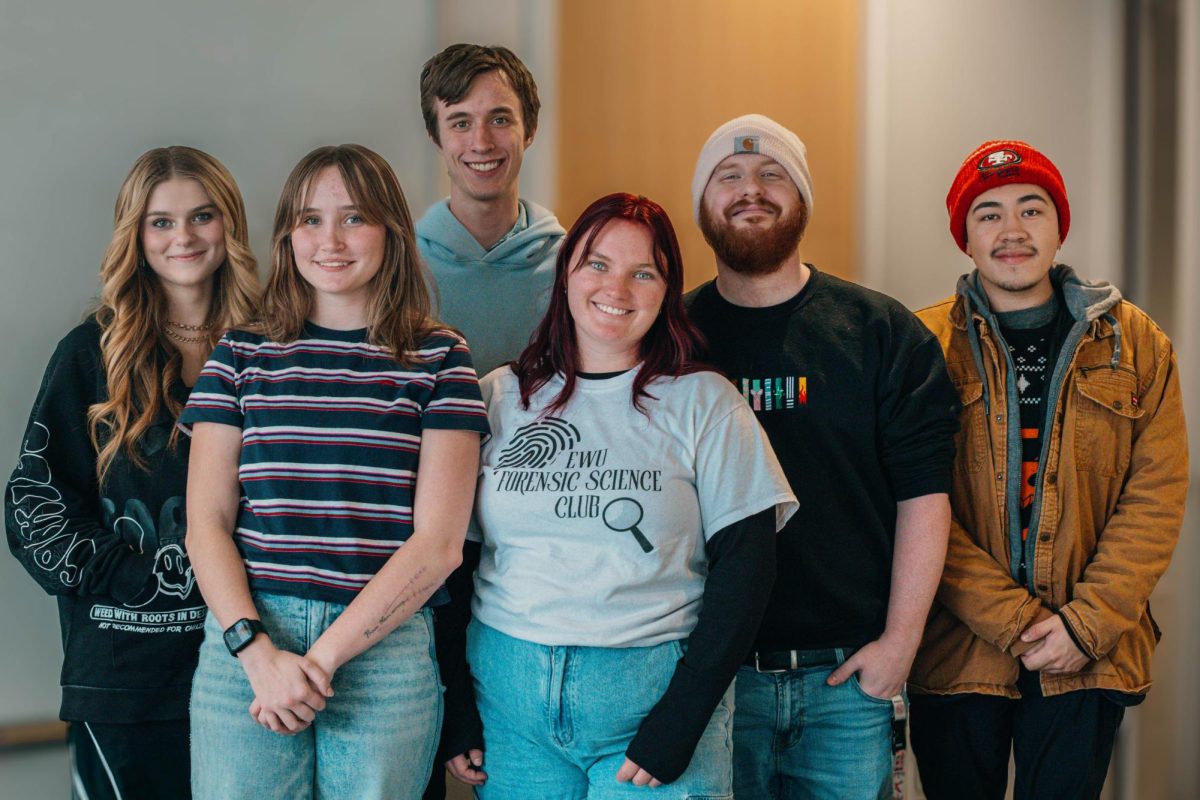
Eastern Washington University’s myriad of student clubs has somewhere for everyone. For those drawn to chemistry, true crime and community, the school’s forensics club is the right fit.
Introduced as an official club in 2019, the forensics clubs had a brief three-year run before it made a comeback in 2024 with new officers and new events.
“We started pretty small, it was just four or five of us,,” said Ross Hudson, the club’s vice-president. “Next thing I knew, our next meeting had thirty kids, and it’s just been consistent ever since. We’re running with it, and building what we can.”
With the surge in membership, the club’s been busy. On Halloween’s Eve, Oct. 30th, the chemistry lab held a grisly scene — a mock crime scene decorated and set-up by the club’s officers.
“(We) said, ‘we came into the lab and we saw this,’” Hudson described, “You know, give them as little as we can give them, and say, ‘tell me what you think happened.’”
With each new theory behind the mock crime scene, the energy in the room grew.
“Seeing everyone approach it in a different way was really interesting. It’s exciting to see everyone get excited about something that all of us are passionate about,” said Hudson.
With the additional membership, Hudson hopes to keep the key components behind the club the same — community of a shared passion being the centerpiece.
“I think it’s important to emphasize the fact that we’re all in the club, and everyone’s unique, you know? Forensics is a small world, but you stick forty different people who see it forty different ways in a room, and you have a bunch of different ways to look at things.”
Inside the small world of forensics, many members have come from all around the country. For Hudson, that meant traveling from Texas for EWU’s formerly offered forensics major. Remaining students have been grandfathered in, though major declarations now list it as a chemistry major with a concentration in forensics. The forensics club serves as a way to keep that passion for forensics alive as the course catalogue shrinks.
But Hudson insists that despite the loss of a forensics major, the club feels supported by the university.
“(EWU) does like us a lot,” Hudson said. “With the increased enjoyment of forensics and Dexter and serial killer documentaries and everything else under the sun, I think it’s only going to get bigger and bigger.”
With events ramping up and membership growing, the forensics club is hopeful to use the club as a space to find a niche — to find a space for everyone.
“Forensics is a really good way to find yourself, in a weird way. Most people, you look at them and you tell them, ‘hey, I love blood spatter,’ and they look at you weird.” Hudson said. “A lot of people come in with misconceptions (of) what they think they’re going to love. And until they’re smack in the middle of a crime scene, you don’t really know yourself that well.”
The forensics club hosts bimonthly meetings and is always looking for new ways to foster the curiously scientific atmosphere they’ve curated — the foundation for what they hope will continue to blossom.
“We’re trying to build, kind of a foundation for everyone that’s there. We all have that one unique thing in forensics that brings us all together,” Hudson said. “There’s digital forensics, entomology, and pathology, and all this other crazy stuff. It sticks people together, and we try to take what everyone loves and teach it to everyone else. So that we build, essentially, the best forensic scientists possible.”