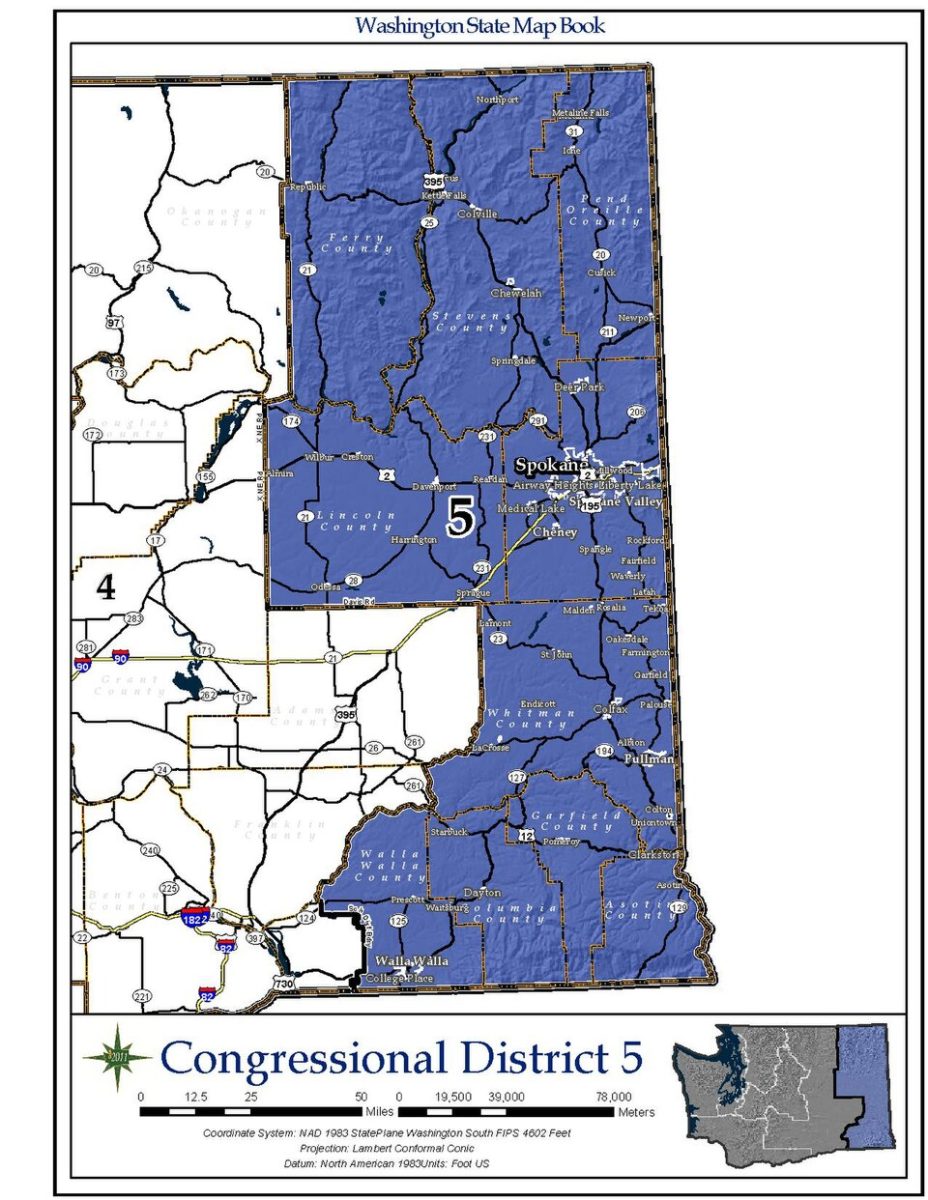
Eastern Washington University hosted a nonpartisan debate for candidates in Washington’s 5th Congressional District on Friday, April 24, bringing federal-level politics directly to campus through a student-led effort aimed at increasing student engagement.
The debate, held from 1 p.m. to 4 p.m. in Hargreaves Hall 201, followed a structured format, with moderators guiding discussion and ensuring each candidate was given equal time to respond.
The event brought together students and community members to hear directly from candidates on issues affecting the region.
Candidates in the race for Washington’s 5th Congressional District, including David Womack, Nate Powell, Bajun Mavalwalla, Carmela Conroy, Ann Marie Danimus and Kevin Fagan, were present at the debate.
Organized by the Political & International Affairs Community (PIAC) in collaboration with the Speech & Debate Club, the event was designed to provide students with a direct, structured opportunity to hear from candidates and engage with issues that affect both the local community and the broader district.
Alesia Levchenko, president of PIAC, said the goal of the event was to create an accessible space for students to engage directly with candidates in a structured and balanced setting.
“We wanted to make sure this was something students could come to and feel informed, regardless of their background or level of political engagement,” Levchenko said.
Levchenko emphasized that the event was intentionally nonpartisan, with PIAC and the Speech & Debate Club serving as organizers to ensure neutrality in both planning and execution.
While several student organizations, including the Student Democrats, supported the event, the structure was designed to prioritize fairness and equal opportunity for all participating candidates.
Jacob Skeim, a representative of the Student Democrats, said the organization’s role as a sponsor was centered on supporting student engagement rather than shaping the event itself.
“Our goal is to help get students involved and aware of what’s happening,” Skeim said. “This gives people a chance to hear directly from candidates and form their own understanding of the issues.”
Planning for the debate began weeks in advance, with organizers coordinating outreach to candidates, developing the event format and working to ensure the discussion would remain accessible to students.
The collaboration between PIAC and the Speech & Debate Club allowed the event to combine political awareness with structured discussion, with each organization contributing to both the content and format of the debate.
Speech & Debate Club President Seamus Mahoney, a junior majoring in environmental policy and planning with a minor in pre-law, said the event offered students an opportunity to better understand both local and federal issues.
“I think having an understanding of what’s happening, both at the federal level and locally, is extremely important,” Mahoney said.
“Even if someone isn’t interested in politics themselves, being aware of what’s going on and engaging with different perspectives can give them a better understanding of their community.”
Mahoney added that much of the preparation focused on creating a format that balances structure with accessibility.
Organizers said the goal was to create a respectful, policy-focused environment that allowed students to hear directly from candidates rather than through campaign messaging.
The event was open to students and the public, offering an opportunity for attendees to engage with the political process in a campus setting. Organizers said they hope the debate will encourage greater awareness and participation among students, particularly as issues at both the local and national level continue to shape their communities.
“We want students to feel like they have a place in these conversations,” Levchenko said.